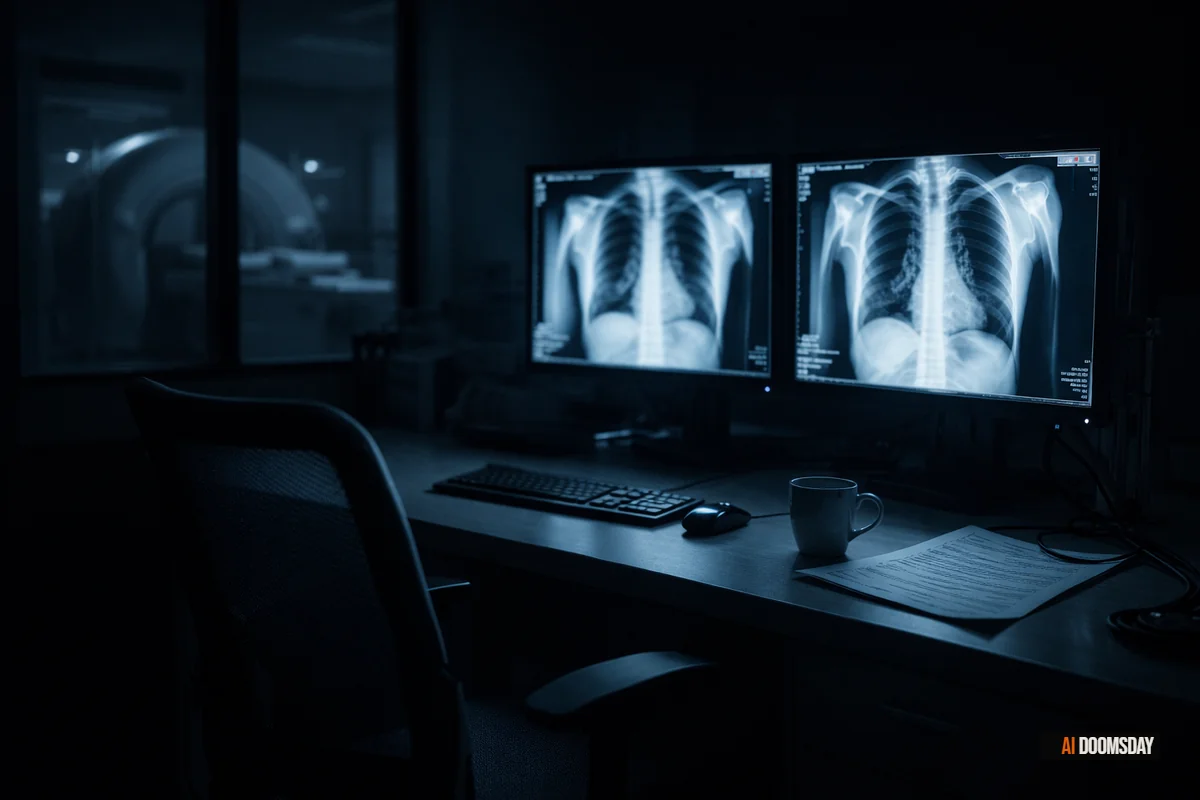
Radiology is the profession everyone cites when they want a clean example of AI threatening knowledge work. The logic is obvious: AI reads images, radiologists read images, therefore something has to give. The reality, as of early 2026, is more complicated and in some ways more unsettling than the simple version. AI is everywhere in radiology now. It is not, by most measures, working as promised. And the profession is changing anyway.
Key Points
- There are 1,039 FDA-approved AI devices in radiology as of early 2026, with 90% of U.S. health systems having deployed at least one, yet only 19% report high success.
- In breast cancer detection, radiologists outperform AI overall (64.5% vs 57%), but AI outperforms in specific subsets such as non-dense breast tissue.
- For intracranial haemorrhage, a radiologist working with AI achieves 99.53% accuracy compared to 90.11% for standalone AI, supporting the augmentation model.
- Harvard Medical School found in 2025 that some AI tools actively degrade diagnostic outcomes, meaning radiologists must now evaluate the tools as well as the images.
- "Navigating the AI diagnostic dilemma" was named healthcare's number-one patient safety concern in 2026 by Radiology Business.
There are 1,039 FDA-approved AI devices in radiology as of early 2026. Ninety percent of U.S. health systems have deployed at least one of them. The market is projected to grow from $300 million to $1.8 billion by 2036, a compound annual growth rate of 23.8%. By the conventional metrics of technology adoption, radiology AI is a success story.
By the metrics that actually matter in a clinical setting, the picture is different. Only 19% of health systems report high success with the tools they have deployed. Forty-one percent of radiologists say current AI tools do not meet real-world clinical needs. This is a technology that has saturated the market without yet satisfying it. The question worth asking is not whether AI will transform radiology. It already has, structurally and economically. The question is what that transformation looks like for the people whose professional identity is built around diagnostic expertise.
The Numbers Don't Resolve the Question
The accuracy data does not offer a clean verdict either. In breast cancer detection, radiologists outperform AI: 64.5% accuracy against 57%. But zoom in and the picture shifts. In non-dense breast tissue, AI specificity reaches 44.4% against a radiologist's 17%. The AI is worse overall and better in a specific, important subset. That kind of conditional performance is genuinely difficult to integrate into a clinical workflow, and it is not what the deployment numbers suggest.
For intracranial haemorrhage, the data points toward collaboration rather than replacement. A radiologist working with AI achieves 99.53% accuracy. Standalone AI reaches 90.11%. The combination outperforms either component alone. This is the finding that augmentation advocates cite most often, and they are right to cite it. The human-plus-AI system is measurably better than either operating independently. What the data doesn't tell us is how that holds as AI models improve, as the 90.11% becomes 94%, then 97%, and the radiologist's marginal contribution to the combined system narrows.
Deployment vs. impact
Ninety percent of U.S. health systems have deployed AI for radiology. Only 19% report high success. That gap is not a calibration problem. It is the distance between a technology that is present and one that is actually working.
Where AI Outperforms, and Where It Doesn't
The performance data for radiology AI is not a single curve trending in one direction. It is a patchwork of conditional results that depend on the modality, the pathology, the patient population, and critically, the quality of the specific tool being deployed. Harvard Medical School researchers found in 2025 that whether AI helps or hurts radiologist performance depends on the quality of the AI tool. That is a precise and damning observation. It means the technology's effect is not uniform. It means some AI tools actively degrade diagnostic outcomes when introduced into a workflow. And it means radiologists are now expected to evaluate the tools they use, not just the images in front of them.
"Whether AI helps or hurts radiologist performance depends on the quality of the AI tool."
Harvard Medical School, 2025
This is a new professional burden without a clear professional framework to support it. Radiologists are being asked to act as AI evaluators, workflow integrators, and diagnostic authorities simultaneously. The speciality is not contracting. It is expanding in scope and complexity at the same time as the core diagnostic task is being automated in parts.
The Second Reader Problem
The current clinical consensus positions AI primarily as a second reader: a triage tool that flags anomalies, prioritises urgent cases, and reduces the time between scan and radiologist review. This is a genuinely useful function. It reduces missed diagnoses in high-volume settings. It shortens time-to-treatment for haemorrhage and pulmonary embolism. The augmentation case here is not theoretical. It is documented and real.
The problem is that "second reader" is a description of today's AI capability, not a stable equilibrium. When AI performs at 90% standalone accuracy on intracranial haemorrhage, the argument for a first reader changes. When it improves to 95%, then 98%, the clinical and economic logic of the two-reader model starts to shift. The second reader framing holds as long as the performance gap between AI and radiologist justifies the additional step. As that gap closes, the workflow question becomes a cost question, and cost questions in health systems tend to resolve in a predictable direction.
The broader debate on AI and jobs has established a pattern: companies adopt AI as an augmentation tool, then discover that augmentation at scale produces efficiency gains that reduce headcount requirements. The health sector moves more slowly than tech. Its regulatory environment is more demanding, its liability exposure is direct and personal, and its professional structures are more durable. But it is not immune to the same logic.
A Profession Updating Its Priors
Eighty-one percent of physicians now use AI tools in their work, up from 38% in 2023. That is a profession updating its priors. The shift happened fast. The satisfaction data did not follow at the same pace. Forty-one percent of radiologists say the tools they are using don't meet clinical needs. That is not a fringe view. It is a near-majority of the speciality expressing scepticism about the technology that is supposedly transforming it.
What that dissatisfaction represents, clinically, is a generation of radiologists who were trained to trust their own diagnostic judgment being asked to integrate tools whose failure modes they cannot fully characterise. The speciality's concern is legitimate and specific: AI can miss the findings it wasn't trained to look for, can underperform on patient populations underrepresented in training data, and can produce high-confidence outputs on cases where confidence is not warranted. "Navigating the AI diagnostic dilemma" was named healthcare's number-one patient safety concern in 2026 by Radiology Business. That is the institutional acknowledgment of a genuine structural problem.
The patient safety signal
"Navigating the AI diagnostic dilemma" was named healthcare's number-one patient safety concern in 2026. The concern is not that AI is failing. It is that no one yet knows with confidence how to tell when it will.
The Uncertainty Is the Threat
The structural argument about radiology and AI is not primarily about whether radiologists will be replaced. In the near term, they will not. The regulatory environment, the liability framework, and the genuine performance gaps in current AI tools all militate against replacement at scale. The argument is about what the profession looks like in ten years and whether anyone can plan a career around a plausible answer to that question.
Anthropic's 2026 labour study documented a 14% drop in job-finding rates for young workers in AI-exposed occupations. Radiology residency programmes are not reporting equivalent numbers yet. The regulatory lag in medicine is longer, and the professional pipeline is more structured. But the underlying logic is the same: if AI absorbs the diagnostic tasks that define the early stages of a radiological career, the training pathway compresses and the entry economics shift. Students choosing a speciality in 2026 are being asked to bet on a fifteen-year career arc in a field whose workflow is being redesigned around a technology whose performance curve they cannot project. That is a genuinely difficult position. The uncertainty itself is the threat.
Larry Fink's argument about which professions survive AI rests on the idea that human judgment, physical presence, and relational trust create durable protection. Radiology has always leaned heavily on the first of those. Its professional identity is built on interpretive expertise: the ability to see what is not immediately obvious in a complex image, to hold diagnostic uncertainty, to integrate clinical context with visual data. That expertise is not disappearing. What is becoming harder to answer is how much of it remains distinctive from what a sufficiently capable model can do, and how that changes as the models improve.
The Wider Cluster
Radiology is the clearest case study in a pattern that extends across diagnostic medicine. Dermatology, pathology, and ophthalmology all sit in the same high-risk cluster: specialities built around image interpretation, pattern recognition, and classification tasks that are structurally similar to what machine learning systems do well. Dermatology AI already matches or exceeds dermatologist accuracy on melanoma classification in controlled studies. Digital pathology systems are being deployed at scale in cancer diagnostics. Diabetic retinopathy screening via AI is FDA-approved and clinically validated.
The progression is not uniform and it is not linear. Each speciality has its own regulatory environment, its own failure modes, its own liability structures. But the direction of travel is consistent. The diagnostic specialities are the portion of medicine most exposed to AI automation, and the exposure is compounding as models improve. Radiology is the furthest along that curve, which makes it the most useful lens for understanding what the others will face.
What Augmentation Buys, and What It Doesn't
The augmentation reality is genuine. AI-assisted radiology catches findings that get missed in high-volume screening environments. It reduces the cognitive load of triage. It frees radiologists to concentrate on complex or ambiguous cases where interpretive judgment matters most. These are real clinical gains and they should not be dismissed.
What augmentation does not do is resolve the structural question. The radiologist as augmented professional is a more productive radiologist. A more productive radiologist in a health system under cost pressure is also a radiologist whose department requires fewer headcount to process the same volume of cases. The efficiency gain goes somewhere. In most institutional settings, it goes to throughput or margin, not to the workforce that helped generate it. This is the same pattern documented in software development, in legal work, in financial services and beyond. The technology augments the individual and reduces the aggregate need for the role.
The honest position, looking at radiology in early 2026, is this: AI is not replacing radiologists now, it is not likely to replace them wholesale in the next five years, and the augmentation benefits are real. It is also true that the profession is structurally vulnerable in a way it was not a decade ago, that the career path for someone entering the speciality today is genuinely harder to map, and that the performance curves of current AI tools are not the right basis for long-term career planning because those curves do not stay where they are.
The Anthropic labour study noted that its theoretical exposure measure was calibrated on 2023 models and likely understates current AI capability. The same caveat applies here. Any analysis of AI and radiology that treats today's performance data as a stable baseline is using the wrong frame. AI learns. It improves continuously. The question is not what it does now but what it will do when it is measurably better, and whether the professional and institutional structures around radiology will have adapted fast enough to absorb that shift. No one has a confident answer to that question. That, precisely, is the problem.