One in four. That is the ratio of game industry professionals who lost their job in the past two years, according to the GDC 2026 State of the Game Industry report, the most comprehensive annual survey of the sector, covering over 2,300 professionals across disciplines, studio types, and countries.
Key Points
- 28% of game industry professionals lost their jobs in the past two years, rising to 33% in the United States, according to the GDC 2026 State of the Game Industry report covering over 2,300 respondents.
- The share of professionals who view generative AI as harmful to the industry went from 18% in 2024 to 52% in 2026, while those who see it as positive fell from 21% to 7%.
- Among visual and technical artists, 64% view generative AI negatively, followed by game designers at 63% and game programmers at 59%.
- 87% of educators expect a negative impact on student placement post-graduation, or report the impact is already visible.
- Only 6% of affected workers were told by employers that AI or automation was the reason for their layoff, a figure that systematically undercounts AI-driven displacement.
The number is 28%. In the United States, it climbs to 33%. One in three.
The number comes from documented, surveyed data: in the span of 24 months, the game industry shed a material fraction of its workforce. And the people left standing are increasingly certain about what drove the collapse.
The curve that accelerates
The most important number in the GDC 2026 report is not the layoff figure. It is the sentiment curve.
In 2024, 18% of game industry professionals believed generative AI was having a negative impact on the industry. By 2025, that figure had risen to 30%. In 2026, it reached 52%.
The numbers describe a compounding acceleration. In two years, the share of professionals who see AI as harmful has nearly tripled. And the counterweight, those who see it as positive, has collapsed in parallel: from 21% in 2024 to 13% in 2025 to just 7% in 2026.
A profession is updating its priors in real time, with lived experience as the dataset. It mirrors the same pattern documented at Amazon: public confidence in AI as a productivity gain collapses once the headcount notices arrive.
Who gets hit first
The survey data is granular enough to identify which disciplines are absorbing the most damage.
Among visual and technical artists, the people responsible for the aesthetic identity of games from concept art to 3D models to texture pipelines, 64% view generative AI as a negative force. Among game designers, the figure is 63%. Among game programmers, 59%.
The economic logic is straightforward: generative models have made certain creative outputs, such as textures, 2D assets, concept references, and environment sketches, producible at near-zero marginal cost. Not because the quality is equivalent. But because the quality is close enough to justify eliminating the headcount.
The result is not that AI has replaced creativity. It is that AI has made certain forms of creative labor economically non-competitive. The distinction matters, because it determines what happens next.
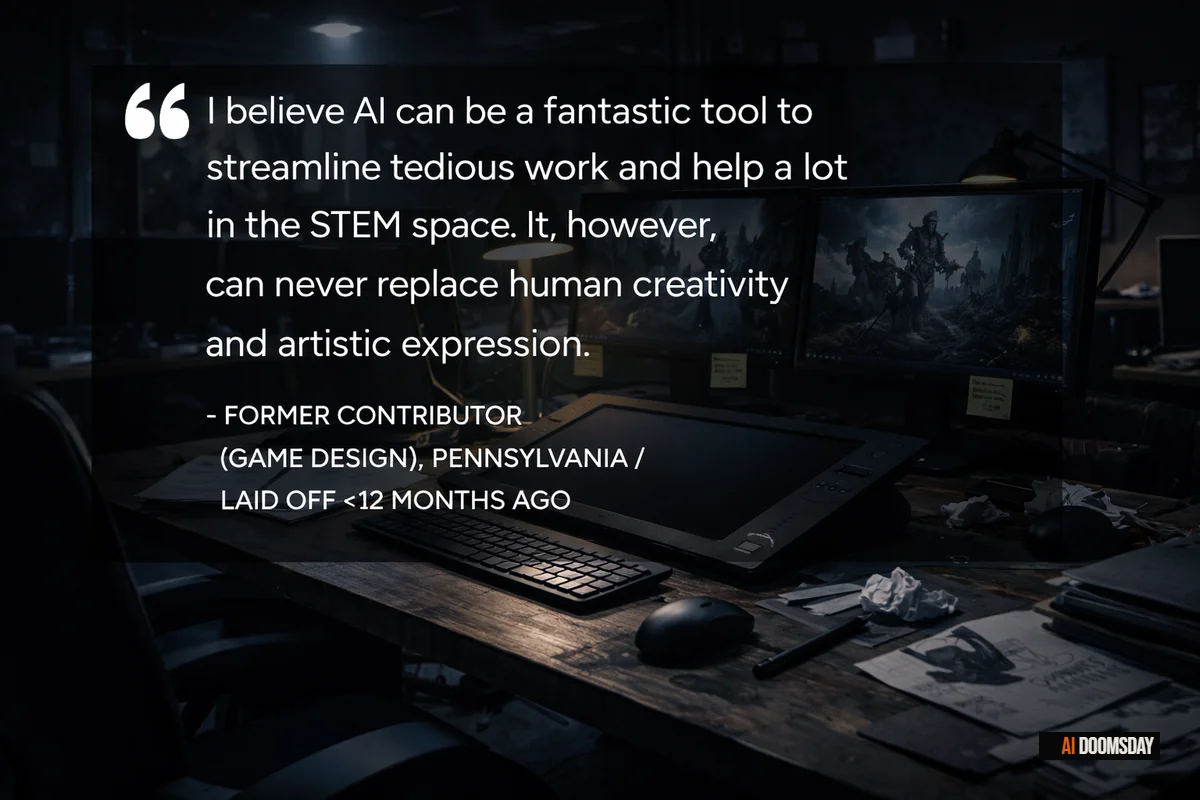
"AI is theft. I have to use it, otherwise I'm gonna get fired."
Senior Employee, Visual and Technical Arts, Ukraine
The speaker is already inside the system, using the tool under compulsion, while naming it precisely. The coercion is the story. Not the tool.
The future that does not arrive
The damage extends beyond those currently employed. The GDC survey included educators and students for the first time at this scale, and the results are unambiguous.
74% of surveyed students said they are concerned about their future job prospects in the game industry. 87% of educators said they expect a negative impact on student placement post-graduation, or that the impact is already visible.
These are people still paying tuition. Still building portfolios. Still preparing for an industry that may not be hiring by the time they graduate. The GDC data has since been cited on the Senate floor: Senator Sanders' March 2026 speech on AI and 100 million jobs used the game industry as one of its primary documented examples of displacement already in progress.
"There aren't any jobs. Everyone's getting fired. It's fucked."
Student, Game Design, California
That quote is not hyperbole. It is the absence of the professional filter that kicks in when you still believe the system will absorb you.
The 6% that does not tell the whole story
The survey asked respondents to identify reasons given by their employers for layoffs. "Automation / AI implementation" was cited by 6% of those affected.
Six percent appears manageable. It is not.
That figure captures only the cases where employers explicitly named AI as the justification, a disclosure that is legally and reputationally costly and therefore systematically underreported. It does not capture the art departments restructured after adopting generative pipelines. It does not capture the positions never opened because a model now covers the output. It does not capture the studio that hired three artists instead of twelve because the other nine roles were quietly absorbed by Midjourney and internal tooling.
Generative AI does not appear in layoff notices. It appears in the decisions that precede them.
What the number hides
When employers cite "restructuring," "cost optimisation," or "strategic realignment," they are not lying. They are describing the outcome of a decision already made upstream, one that rarely names its instrument. AI displacement is counted in headcount ratios and pipeline decisions, not in the documented reasons on a severance form.
Where this trajectory leads
If the sentiment curve maintains its current trajectory, doubling its negative reading every twelve months, the majority of game industry professionals will view generative AI as a net harm before the end of 2026. If educators continue to warn students away from the sector, the pipeline of incoming talent will begin to reflect that pressure within three to five years.
The question this report raises is not whether AI is good or bad for the game industry. That debate has already been settled, at least among the people who make games for a living.
The question is what kind of industry emerges from this transition, and whether the people who built it will be inside it when it does. For a broader picture of how this displacement is playing out across sectors, see our full coverage in AI and Jobs.