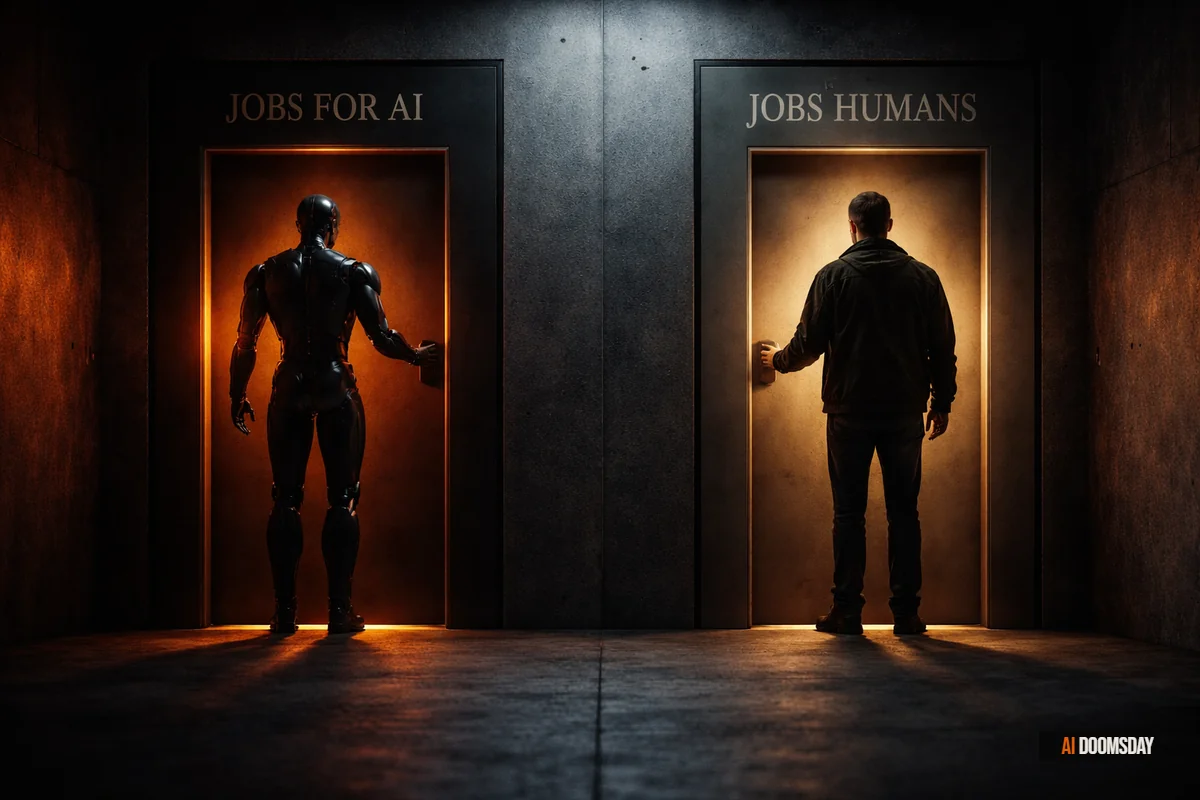
For thirty years, the standard advice held: the more education you have, the safer you are from automation. Get a degree, enter a profession, work with your mind instead of your hands. The machines would take the repetitive, physical, low-skill work first. The rest of us would be fine.
Microsoft Research just published data that inverts that logic almost entirely.
Key Points
- Microsoft Research measured AI task applicability across hundreds of occupations using real Microsoft Copilot usage data, then cross-referenced findings with Bureau of Labor Statistics occupation profiles.
- The protective factor against AI displacement is not education level: college-educated workers in desk-based roles show higher AI exposure than workers in manual trades without degrees.
- The 20 most AI-exposed occupations are almost entirely desk-based roles that process information, communicate in natural language, and operate in stable digital environments, including translators, journalists, financial advisors, and web developers.
- The 20 safest occupations are almost all defined by physical presence, environmental unpredictability, or accumulated haptic expertise: roofers, plumbers, surgical assistants, commercial divers.
- The demographic cost is not evenly distributed: clerical and administrative support, the most AI-exposed category, employs a workforce that is 86% women, with fewer pathways out than any comparable exposed group.
The research does not speculate about future capabilities. It describes what is already happening: which tasks AI tools are actually performing today, mapped against which jobs are built from those tasks. The findings are not theoretical. They are descriptive. And what they describe is a labour market where physical work has quietly become the safer bet.
The Research Nobody Wanted to Read
Microsoft Research built their methodology around something most AI labour studies do not have access to: real usage data. By analysing the actual tasks performed through Microsoft Copilot at scale, the researchers could measure which professional activities AI tools are already executing, rather than which ones they theoretically might. That data was then mapped against Bureau of Labor Statistics occupation profiles, which catalogue the component tasks of each profession in standardised terms.
The result is not a model. It is a measurement. When Microsoft's data shows that 49% of the task profile for interpreters and translators is already covered by AI, that figure does not describe a projection. It describes what Copilot users are already doing with the tool today.
The 49% figure for translators is, if anything, the number that should end the conversation about whether AI can handle nuanced language work. It has not ended anything, because the people with the most invested in that conversation have strong incentives to keep it going. But the data is there.
Anthropic's own research on programmers found comparable results: 74.5% task coverage for software development roles. Two of the most credentialled, well-compensated categories in the knowledge economy, measured against the same benchmark, showing the same pattern. The degree does not protect you. The task profile does. And task profiles built on language, analysis, and structured information processing are exactly where AI is strongest.
The Variable That Protects You
The Microsoft data does not reveal a simple correlation between education and risk. It reveals something more precise: the structural characteristics of work that make AI displacement difficult. Four of them recur across the safest occupations in the research.
The first is embodied labour. Tasks requiring fine motor coordination, physical presence, and real-time adaptation to a three-dimensional environment remain beyond current AI capabilities not because the technology is immature, but because the problem is fundamentally different in kind. A roofer does not process information and output a document. A roofer climbs a structure that is different every time, solves problems that reveal themselves only on site, and uses their body as the primary instrument. No large language model can wire a circuit breaker panel.
The second is environmental unpredictability. AI systems perform well when variance is bounded. A translation task, a code review, a financial analysis: these operate within defined problem spaces with measurable outputs. Every construction site, every plumbing installation, every surgical procedure takes place in a context that is irreducibly specific. The pipe is in a different place than the blueprint shows. The patient's anatomy deviates from the norm. The soil condition is not what the survey indicated. These are not edge cases. They are the job.
The third is haptic expertise. A master electrician or an automotive glass installer carries years of accumulated muscle memory that is not accessible through language or images. That knowledge lives in the nervous system, refined through thousands of hours of physical practice. It cannot be transferred to parameters. A surgical assistant's hands know things that are not in any training dataset.
The fourth is human presence as the product. For massage therapists, nursing assistants, and personal care workers, the value delivered is not informational. It is relational and physical. The patient is not paying for a conclusion. They are paying for a body in the room, performing a physical act. That is not automatable in any meaningful sense, not because AI could not simulate the information component, but because the information component is not the point.
The data point that cuts through every intuition about this: the level of educational attainment attached to a role is not protective. The Microsoft research shows that roles requiring college degrees demonstrate higher average AI task applicability than roles in manual trades. The credential economy built its pitch on the premise that cognitive work was safe. That premise was wrong. Larry Fink made the same intuition about physical work in his 2026 shareholder letter, and framed it as infrastructure bottleneck. Microsoft's data frames it as evidence.
The 20 Jobs Most at Risk
The pattern across the most exposed occupations is consistent. These roles share three characteristics: they process or generate language, they operate in stable digital environments, and their output is a document, a report, a communication, or a recommendation. The physical world does not enter into the work. The task profile is, in effect, a description of what AI currently does best.
- Interpreters and Translators — 49% of task profile already covered by AI tools. The work is language conversion in bounded contexts. Copilot does this at scale.
- Customer Service Representatives — Structured conversational problem-solving with defined resolution paths. The highest-volume deployment category for enterprise AI today.
- Technical Writers — Documentation from structured source material. High AI task overlap because the output format is standardised and the source material is well-defined.
- Writers and Authors — Content generation, drafting, and editing are core LLM capabilities. The exposure is highest in commercial and journalistic writing contexts.
- Journalists and News Analysts — Structured research, synthesis, and narrative production. AI tools are already generating routine news items at major outlets.
- Editors — Language refinement, structural review, and consistency checking. Tools like Copilot perform these tasks within document workflows.
- Market Research Analysts — Data gathering, synthesis, and report generation. The research and presentation layer is highly automatable with current tools.
- Management Analysts — Process documentation, recommendation generation, and strategic synthesis. Consulting firms are already deploying AI for junior analyst tasks.
- Personal Financial Advisors — Portfolio analysis and recommendation generation involve structured data and rule-based reasoning: a core LLM application domain.
- Web Developers — Code generation and debugging are among the highest-volume Copilot use cases. Anthropic's research on programmers documents 74.5% task coverage.
- Data Scientists — Analytical pipeline construction and interpretation have high AI task overlap, particularly in routine analysis and visualisation work.
- Sales Representatives (Services) — Outreach scripting, lead qualification, and CRM management are already heavily automated. The AI layer is displacing entry-level sales roles first.
- Broadcast Announcers and Radio DJs — Voice synthesis and content scheduling are mature AI applications. Automated broadcasting is already deployed in several markets.
- Public Relations Specialists — Media relations, press release drafting, and messaging strategy operate largely within the language generation domain.
- Business and Economics Teachers — Curriculum delivery in structured, text-based domains has significant AI overlap, particularly for foundational content.
- Historians — Research synthesis, source analysis, and narrative construction are language-intensive tasks with high AI applicability.
- Telemarketers — The most obvious case: scripted voice-based sales has been partially automated for years. AI closes the remaining gap.
- Travel Agents and Ticket Clerks — Booking, logistics, and recommendation tasks operate within well-defined information environments. Already heavily disrupted by AI-integrated platforms.
- Telephone Operators — Routing and information tasks in structured conversational contexts. Near-complete AI coverage for the core task profile.
- Passenger Attendants — Information provision and logistics coordination in standardised environments. High overlap with AI assistant capabilities in structured service contexts.
The 20 Jobs That Are Safe (For Now)
The safest occupations share the inverse profile: they all require a body somewhere specific, doing something that cannot be reduced to information processing. The environments are variable. The skills are physical. The presence is the product.
- Dredge Operators — Operating heavy equipment in underwater and waterway environments. Physical presence, real-time environmental adaptation, and manual precision define the work.
- Bridge and Lock Tenders — Structural operation in variable real-world conditions. Requires on-site physical judgment that cannot be managed remotely at scale.
- Water Treatment Plant Operators — Physical monitoring, maintenance, and adjustment of infrastructure systems. Conditions vary and equipment requires hands-on intervention.
- Foundry Mold and Coremakers — High-heat manual manufacturing requiring physical dexterity and real-time material judgment. The working environment is among the least digitisable in industry.
- Rail Equipment Operators — Physical operation and maintenance in variable field conditions. Safety-critical manual tasks with high context-sensitivity.
- Pile Driver Operators — Heavy equipment operation in construction environments where site conditions dictate execution. Physical expertise and real-time judgment are the core competencies.
- Logging Equipment Operators — Variable terrain, unpredictable environmental conditions, and safety-critical physical operation. High embodied expertise requirement.
- Roofers — Each structure presents different conditions. The work is physical, elevation-based, and requires continuous real-world adaptation.
- Plumbers — Installation and repair in environments where no two jobs are identical. The work requires physical navigation of existing structures, variable materials, and non-standard conditions.
- Construction Laborers — Physical site work across variable conditions. The task set is broad, physical, and context-dependent in ways that resist standardisation.
- Automotive Glass Installers — Precision physical work with variable vehicle types and installation conditions. Haptic expertise is central to the craft.
- Commercial Divers — Underwater physical work in highly variable and safety-critical environments. Remote operation is not a practical substitute for the tasks involved.
- Surgical Assistants — Physical presence in an operating environment, executing real-time manual support tasks under surgical direction. The embodied component is irreducible.
- Massage Therapists — Physical contact is the product. The value is not informational. The work cannot be delivered without a body in the room.
- Nursing Assistants — Physical care tasks, patient movement, and hands-on monitoring. The role is defined by physical presence and real-time human response.
- Phlebotomists — Manual precision in a clinical environment, with each patient presenting differently. Physical skill and situational adaptation define the task profile.
- Janitors and Cleaners — Physical work in variable environments requiring real-time spatial navigation. Broad deployment of cleaning robots remains constrained by the complexity of real-world spaces.
- Landscaping Workers — Physical outdoor work in conditions that vary by site, season, and specification. Highly context-dependent task execution.
- Painters and Drywall Installers — Manual craft work where surface conditions, environment, and finish standards vary continuously. Haptic expertise is central.
- Pest Control Workers — Physical inspection and treatment in variable site conditions. Requires on-site environmental judgment that does not reduce to a decision tree.
The Education Paradox
The most uncomfortable finding in the Microsoft research is not about any specific occupation. It is about the relationship between educational attainment and AI exposure. For decades, the standard argument was that automation would move upward through the skill ladder slowly: first the routine physical jobs, then the semi-skilled, then perhaps, far in the future, some fraction of highly credentialled cognitive work. The timeline would give educated workers enough distance to adapt.
That timeline was based on an assumption about what AI could do. The assumption was wrong. The jobs that are most exposed today are not low-credential, routine physical roles. They are high-credential, language-intensive, information-processing roles. A translator with a master's degree in linguistics is more exposed than a plumber with a trade certificate. A financial analyst with an MBA is more exposed than a roofer with no formal qualification beyond their license.
This is not a critique of education as a human good. Knowing things is valuable independent of labour market returns. But the argument that education protects against automation was always a claim about task structure, not about credential signalling. It assumed that the cognitive tasks associated with high education were uniquely hard for machines. The Microsoft data shows that assumption has expired. 49% of a translator's task profile. 74.5% of a programmer's.
Which professions are mutating under AI pressure is now a different question than which professions require the most years of study. The two variables have decoupled. Credential-heavy work in language and analysis is the current target. Credential-light work in physical environments is the current refuge. The education system has not yet adjusted its pitch to account for this.
Who Pays the Cost
The distribution of risk is not demographically neutral. The most exposed occupational category in the Microsoft data is clerical and administrative support. That category employs a workforce that is, by consistent Bureau of Labor Statistics measurement, approximately 86% women. These are the roles with the highest concentration of AI task overlap and, simultaneously, the fewest pathways into the categories that are currently protected.
The structural exposure
The most AI-exposed occupation category, clerical and administrative support, employs a workforce that is 86% women. These workers face the highest AI overlap and the fewest transition pathways.
The transition to physical trades is a legitimate option for workers entering the labour market now. For a 42-year-old administrative coordinator, it is a different proposition. Retraining narratives consistently underestimate the cost of transition for workers in mid-career: the physical demands of trades entry, the income gap during apprenticeship, the geographic constraints, the family obligations that make extended retraining economically impossible.
It is also worth naming what does not appear in the Microsoft research: the policy infrastructure that would make this transition achievable at scale. The data maps the exposure. It does not map the route out. And routes out of highly feminised, AI-exposed administrative work into the physical trades, which remain male-dominated and geographically concentrated, do not currently exist at a scale that matches the displacement being measured.
This is not only a labour market problem. It is a structural problem with a demographic shape that deserves to be named directly.
The ATM Fallacy
The Microsoft research paper includes a responsible disclaimer that deserves its own scrutiny. The researchers note that AI task overlap should not be read as a direct prediction of job loss. They cite the ATM example: when ATMs automated cash dispensing, bank teller employment did not collapse. It grew, because lower per-transaction costs allowed banks to open more branches, expanding the total demand for teller services.
The analogy is honest as far as it goes. It does not go far enough.
The ATM-teller story worked because the market for retail banking expanded as the cost per service fell. New branches absorbed the labour that individual branches no longer needed. The demand side grew fast enough to absorb the supply-side efficiency gain.
The question is whether that dynamic applies to the occupations currently most exposed. Demand for translation services does increase as AI lowers the cost per word. But the number of human translators paid to perform that work does not necessarily increase with it. Demand for financial analysis grows. The number of human analysts required to service that demand shrinks. Demand for content grows. The number of writers employed to produce it compresses.
The ATM model describes a market that expanded because the infrastructure of delivery (bank branches) was a bottleneck that lower transaction costs allowed firms to relieve. In knowledge work, the infrastructure of delivery is the human worker. When AI reduces the cost of translation, there is no new branch to open. There is just less work for translators.
The disclaimer is not wrong. It is insufficiently honest about when the analogy does and does not hold.
The Microsoft research is a map. It describes where you are, with unusual precision. It does not tell you where to go from here. But cartography has always been useful precisely because it tells you the truth about the terrain, regardless of whether the terrain is convenient. This one is not convenient. The question is what you do with knowing it.