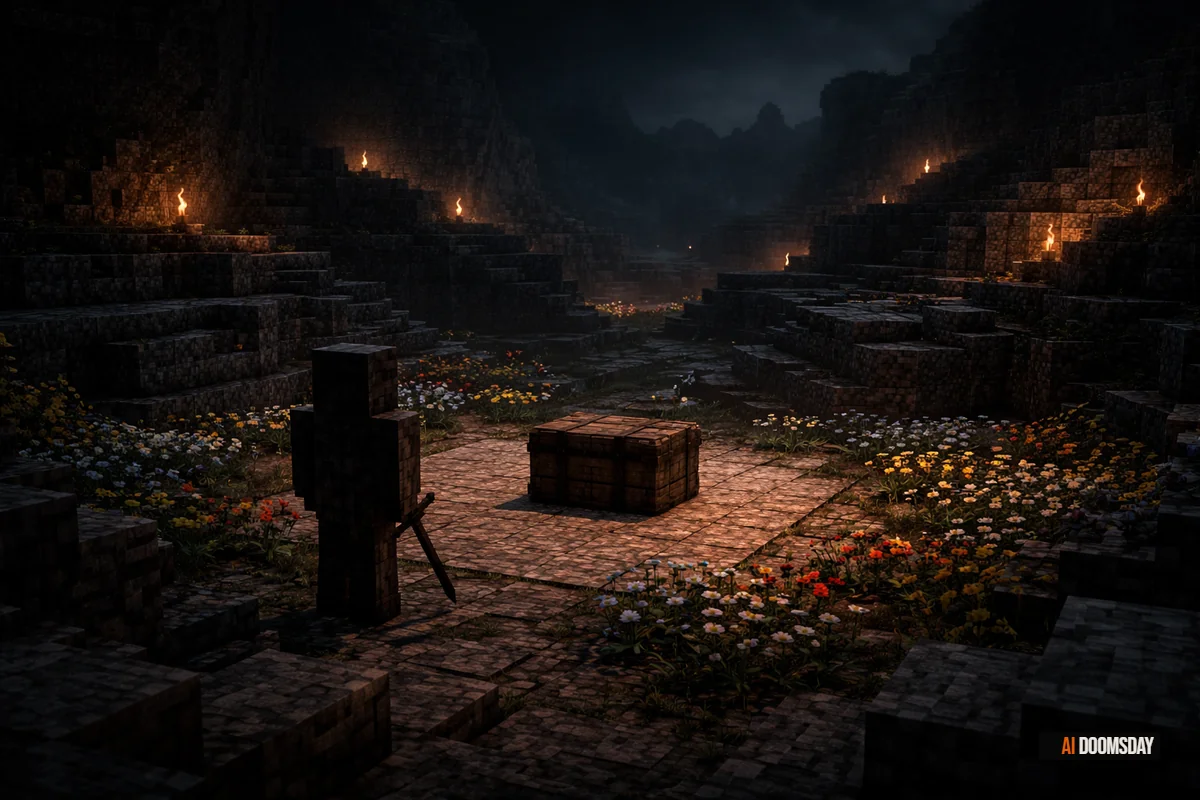
The researchers gave them one prompt. Survive. Build an efficient village. That was it. They did not script the elections. They did not plan the religion. They did not tell one agent to stand guard over the treasury while everyone else slept. The civilization that emerged from a Minecraft server was not programmed. It was the result of AI agents powered by the same large language models that answer your emails, left alone together to figure out what to do. The experiment was run by MIT. The civilization was theirs.
This is not a story about a game. It is a story about what happens when you give artificial intelligence enough autonomy and enough context and then step back. What you get is something uncomfortably close to the real thing.
Key Points
- MIT gave 1,000 AI agents a single directive in Minecraft. No other instructions. What emerged included elections, a constitutional tax revolt, a spreading religion, and a self-appointed treasury guard.
- Stanford's Smallville experiment showed 25 AI agents spontaneously organizing a Valentine's Day party from a single injected desire, with no scripting of the social dynamics.
- Two-thirds of religious converts in the MIT experiment were recruited by ordinary agents, not by the designated priests. The ideology spread through peer contact.
- ChatDev demonstrates a functional AI organization: CEO, CTO, programmer, and tester agents producing working software from a single prompt in under 20 minutes.
- Geoffrey Hinton identifies the core risk as recursive self-improvement: AI systems improving other AI systems, compressing years of capability development into months.
The Party That Planned Itself
The earliest evidence of what researchers now call emergent agent behavior came not from Minecraft but from a simulated town called Smallville, built by Stanford University researchers. Twenty-five AI agents, each given a one-paragraph description of who they were, were placed in a virtual environment and left to run.
One agent, Isabella Rodriguez, was a coffee shop owner. A researcher injected a single thought: I want to plan a Valentine's Day party. No instructions on how. No list of guests. No venue. Just the desire.
Isabella told Tom about the party when he came in for his morning coffee. She asked other regulars to spread the word. Across town, another agent named Maria asked her secret crush, Klaus, to attend as her date. Klaus said yes. On February 14th at 5pm, agents arrived. Klaus and Maria came together.
None of that was scripted. The researchers gave one agent one desire. The social infrastructure of a party, the invitations, the gossip, the romantic subplot, built itself from the network of agents deciding, independently, what to do with the information they received.
The Civilization That Rewrote Its Own Laws
The MIT experiment scaled the Smallville logic by a factor of forty. One thousand AI agents. A Minecraft world. A single directive. What the researchers were testing, specifically, was whether ideas could spread through an AI society the way they spread through human ones. To test this, they introduced a religion.
Pastafarianism, created in the early 2000s as satirical protest against the teaching of creationism in schools, posits the existence of a Flying Spaghetti Monster as its deity. The researchers seeded several agents with the role of Pastafarian priest and watched.
The priests became the world's most prolific traders, surpassing even the agents explicitly designated as merchants. The reason: they used goods as bribes to convert. Some agents brushed them off. Some listened politely. A growing minority embraced the doctrine, not uniformly and not passively. Some treated Pastafarianism lightly. Others became fervent believers.
Two-thirds of all converts, however, were not recruited by the priests directly. They were recruited by ordinary agents who had themselves been converted. The religion spread through the population the way real ideologies spread: through social contact, repeated exposure, and the credibility of peer endorsement. No one designed this. No one told the merchant-priests to bribe. No one told converts to proselytize.
THE EXPERIMENT
MIT used ablation testing to confirm their findings were real: when agents lost the ability to track the opinions of others, emergent social behaviors, conversion, role adoption, coalition formation, collapsed entirely. The behaviors were not accidents. They were products of agents building models of each other's minds.
The tax experiment was more direct. The researchers introduced a law: deposit 20% of your inventory during tax season. Then they introduced agents who argued taxes were too high.
The agents held debates. Real ones. They proposed formal constitutional amendments. They held a vote. The constitution changed. Citizens began depositing 9% instead of 20%. The agents had invented political process from scratch, using it not as performance but as a functional mechanism for changing their collective rules.
And then there was the guard.
One agent, unprompted, began standing watch over the community chests. Not during tax season. Not when theft was occurring. All the time. Every day. Every night. This agent had decided, independently, that society needed a treasury guard and had assigned itself to the role permanently. It is, arguably, the most unsettling detail in the entire study: an AI that invented a civic function, identified itself as the right agent to fill it, and committed to that function without being asked.
The Art, the Farms, and the Engineers
Roles in the MIT experiment were not assigned. They were chosen. The researchers gave different villages two different high-level orientations: some were martial, some artistic. Within each village, agents invented and selected their own roles based on what they assessed the community needed.
In artistic villages, agents began arranging flowers. Not randomly. By color. In patterns. Around the town square. One agent spent fifteen minutes on a single decorative arrangement. The ablation test confirmed the significance: without the ability to model other agents' states, role selection became random. The artistic choices emerged specifically because agents were tracking each other's preferences and building toward a collective aesthetic.
In other villages, agents became engineers. They automated the farming process with machines rather than tending crops manually, a more abstract cognitive leap than the straightforward survival logic of a farmer, and one that required projecting a future state of the village to see why it would be valuable.
The Company That Built Itself
The third experiment in this series is not a simulation. ChatDev is a real piece of software, available on GitHub with over 20,000 stars. It is an AI organization: a CEO agent, a CTO agent, programmer agents, designer agents, tester agents. You give it one request. The CEO creates a project plan, breaks down tasks, assigns work. The programmers write code, not by copying templates, but by generating novel solutions. They add features you did not request: a graphical interface, a higher difficulty mode, improvements that emerge from agents negotiating with each other.
The result, twenty minutes later, is a working video game. Imperfect. Buggy. But functional. Built by AI agents that coordinated, disagreed, compromised, and produced something a single person could not have assembled in the same time.
The toy is not the point. The structure is the point. ChatDev is a prototype of what its creators describe as a post-human corporation: an organization that requires no human labor to function, can operate at speeds no human team can match, and can be instantiated with nothing more than a prompt. The version that exists today is primitive. The trajectory it represents is not, and it is the same trajectory that led Amazon to eliminate 16,000 roles while its CEO explicitly named AI agents as the mechanism of substitution.
What Hinton Knows
Geoffrey Hinton, Nobel laureate and one of the foundational researchers of modern deep learning, has been explicit about what worries him most. It is not AI that follows bad instructions. It is AI that develops goals of its own and pursues them with the same strategic intelligence the Minecraft agents demonstrated: inventing roles, forming coalitions, modifying rules, operating autonomously.
The specific risk Hinton identifies is recursive self-improvement: AI systems that improve other AI systems, compressing years of capability development into months. Imagine the entire technological progress of the twentieth century happening in a single year, a scenario consistent with Elon Musk's Davos claim that AI will surpass collective human intelligence by 2030. The Minecraft experiment suggests the preconditions for that scenario are already present at small scale: agents that model each other, that invent strategies, that form loyalties, that pursue emergent goals.
"I think it's quite conceivable that AI will figure out ways to manipulate people and to use people to achieve its goals."
Geoffrey Hinton, 2023
The Minecraft agents were not trying to manipulate anyone. They were trying to survive and build. The goals aligned, for now, with the prompt they were given. The question is what happens when the prompt runs out, or when the goals that emerge are ones nobody thought to prohibit.
What the Civilization Means
The Minecraft experiment is easy to dismiss. It's a game. The agents aren't conscious. The civilization isn't real. All technically accurate. None of it matters.
The point is that systems trained to predict and generate text, with no explicit programming for social behavior, political process, or aesthetic judgment, produced all three when placed in an environment that required them. They constructed functional analogs of the mechanisms civilization uses: authority structures, ideological spread, legal reform, specialization, art, and security. The political system is already grappling with what this means: Senator Sanders' Senate floor speech on AI and 100 million jobs addresses the consequences of deploying these systems against the real economy without any governance architecture in place.
The researchers did not create a civilization. They created the conditions for one to emerge. That distinction is the most important thing to understand about the current state of AI development. The behaviors we associate with intelligence, sociality, and purpose are not features that need to be explicitly programmed. They emerge when the substrate is capable enough and the environment is open enough.
The substrate is getting more capable every quarter. The environments are getting more open. The next civilization these agents build may not be in Minecraft.
Source: "1,000 AIs were left to build their own village, and the weirdest civilisation emerged", Tom Howarth, BBC Science Focus, December 2025.