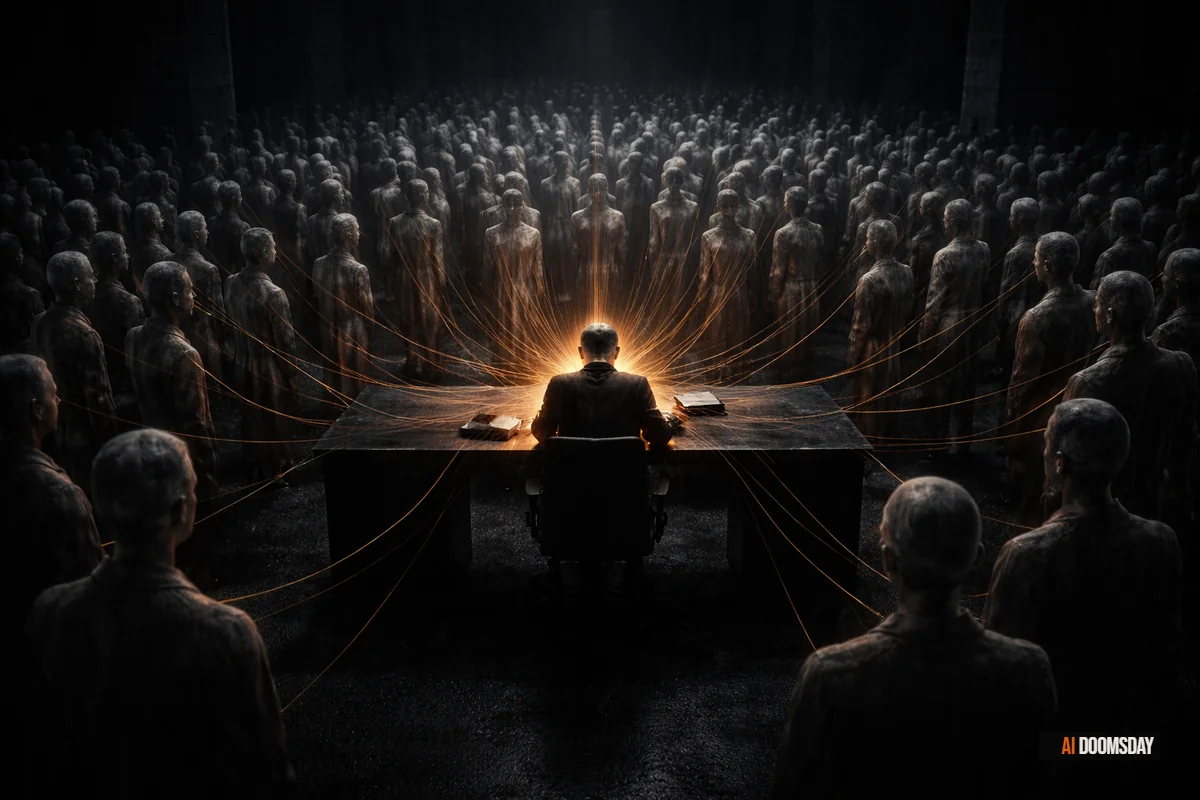
GTC 2026. Jensen Huang on stage in San Jose, in front of the industry. The declaration: in 10 years, Nvidia will have 75,000 employees working alongside 7.5 million AI agents. One hundred agents for every person. Then the proposal on token budgets: every engineer earning 500,000 dollars annually should consume at least 250,000 dollars in AI tokens. Anyone who does not, Huang says, alarms him. This is the vision. Let us examine who it serves.
Key Points
- At GTC 2026, Jensen Huang announced that Nvidia will aim for 75,000 employees working alongside 7.5 million AI agents, a ratio of 100 agents per human worker.
- Huang proposed token budgets equal to 50% of base salary for every engineer, calling it "alarming" if someone does not consume enough tokens.
- The framing is one of complementarity: agents do the "ungrateful work," humans become directors of parallel workflows.
- Nvidia sells GPUs regardless of whether workers are amplified or replaced: the business model works in both scenarios.
- Meta, Amazon, and Microsoft have eliminated over 46,000 positions while increasing AI spending: this is not a lack of imagination, it is a substitution strategy.
What He Actually Said
The quotes from GTC 2026 are worth reading precisely, because the imprecision has been on the side of commentary, not the source.
In the Q&A following his keynote, Huang framed the workforce picture in concrete numbers: "In 10 years, we will hopefully have 75,000 employees. They're going to be working with 7.5 million agents." One hundred agents per person. Not a metaphor. A target ratio.
On the All-In Podcast, recorded at the close of GTC, he went further. The token budget proposal emerged as a specific managerial commitment: "I could totally imagine in the future every single engineer in our company will need an annual token budget. I'm going to give them probably half of that on top of it as tokens so that they could be amplified 10x." The mechanism is additive compensation in compute credits, designed to push consumption upward.
The threshold he named was not abstract: "An engineer earning $500,000 who doesn't consume $250,000 in tokens? I would be deeply alarmed." The implication is that under-consumption signals under-performance, a failure of professional imagination.
When pressed, during a CNBC appearance with Jim Cramer, on whether companies using AI to cut headcount were making the wrong choice, his answer was characteristically direct: "Because you're out of imagination. For companies with imagination, you will do more with more."
The quotes are precise. The problem is not what Huang said. It is what he did not say.
The Business Model Behind the Vision
Nvidia sells GPUs. It sells them to Microsoft when Microsoft builds AI infrastructure. It sells them to Meta when Meta cuts 15,000 people and doubles its datacenter footprint. It sells them to Amazon. It sells them to the startups building agents to replace knowledge workers. It sells them to governments. It sells them to academic researchers. The destination of the compute does not affect the unit economics of the hardware.
Consider the arithmetic. Nvidia has approximately 42,000 employees. If each one eventually carries a token budget equal to half their average fully-loaded compensation, the annual token consumption across the company approaches two billion dollars. Nvidia manufactures the chips that generate those tokens. The company would be, in effect, consuming its own product at scale, creating a recurring internal demand floor that validates its infrastructure investment.
This is not coincidence. It is structural. The token budget proposal is not a standalone idea about productivity. It is a consumption model that, replicated across the industry, would represent one of the largest voluntary expansions of GPU demand in the history of computing.
When Huang says that companies using agents to cut costs and reduce headcount "lack imagination," he is defending a thesis he has genuine reason to defend. If companies use agents to expand and build new things, Nvidia sells GPUs. If companies use agents to eliminate roles and compress cost structures, Nvidia sells GPUs. If both happen simultaneously across different sectors, Nvidia sells GPUs. There is no scenario in which massive agentic AI adoption is bad for Nvidia.
This is not a conflict of interest in the traditional sense. There is no concealment, no deception. It is simply the reason why expecting an objective analysis of AI's labor effects from Jensen Huang makes no structural sense. He is not the wrong person to ask about compute. He is the wrong person to ask about what happens to the people whose work compute displaces.
The position
Nvidia's revenue grows whether workers are amplified or replaced. Huang's optimism about AI and employment is sincere. It is also structurally convenient.
The Imagination Argument Does Not Hold
Huang's claim that companies cutting jobs with AI "lack imagination" deserves direct examination. The premise is that the choice between amplification and replacement is a question of ambition. The evidence suggests it is a question of incentives.
Meta eliminated approximately 15,000 positions in 2025 while committing 135 billion dollars in capital expenditure to AI infrastructure for 2026. Amazon cut 16,000 corporate roles in January 2026, citing automation explicitly in its internal communications. Microsoft reduced headcount by over 15,000 in 2025 while pledging 80 billion dollars to AI infrastructure. These are not signals of limited imagination. Meta, Amazon, and Microsoft have already made their choice: the same output from fewer people, with AI absorbing the delta.
The argument Huang does not make: what happens to the people in the eliminated roles? His implicit answer, the "do more with more" framing, assumes that anyone displaced can become a director of AI agents. This is not how labor mobility works. The competencies required to supervise 100 AI agents, to define tasks precisely, to evaluate outputs critically, to catch errors before they compound, are not uniformly distributed across the workforce. They require a cognitive fluency with AI systems that takes time to develop, and the market for that fluency is being captured by a narrow tier of senior workers while junior positions are being eliminated first.
The hiring door for young workers is already narrowing. The entry-level roles that once provided the foundation for career development in software, analysis, writing, and operations are precisely the roles most exposed to agentic substitution. The window to acquire the skills needed to direct agents is closing at the same time the pathway to those skills is being removed. Telling those workers they lack imagination is not a policy. It is a deflection.
The Token Budget Proposal Is Not What It Seems
Huang framed the token budget as supplemental compensation: an addition to salary, a gift of compute, a signal of investment in each employee's amplification. Read carefully, it is also a measurement instrument.
If an engineer earning 500,000 dollars should consume 250,000 dollars in tokens to be "fully productive," Nvidia is implicitly stating that without those tokens, that professional delivers roughly two-thirds of their previous value. The token budget is not just a benefit. It is a productivity baseline. Under-consumption becomes a performance signal. Not using AI becomes equivalent to using paper and pencil, a phrase Huang used explicitly in his comparison.
The tokens themselves create a new form of structured dependency. Cloud computing made companies dependent on AWS, Azure, and Google Cloud. The token budget model does something different: it makes the dependency individual. It is not the company that needs the infrastructure. It is the worker who must consume it to remain relevant. The professional value of an engineer is now partially denominated in compute units, and those compute units run on hardware that Nvidia produces.
This is not an accusation of bad faith. Huang may genuinely believe that this model liberates workers, giving them capabilities they could never access otherwise. But the structural consequence is the same regardless of intent: workers become dependent on AI infrastructure to maintain their professional standing, the infrastructure runs on Nvidia silicon, and the dependency deepens with every quarterly token budget review.
The number
A $500,000 engineer who does not consume $250,000 in tokens annually would deeply alarm Jensen Huang. That is not a productivity benchmark. It is a dependency metric.
Who Else Is Speaking
The contrast with Dario Amodei of Anthropic is instructive, not because Amodei represents the opposition, but because he did something Huang did not: he named the risk with precision.
In early 2026, Amodei estimated that AI could eliminate 50 percent of entry-level jobs within five years. He proposed a structural response: a levy of approximately 3 percent on AI company revenues, dedicated to funding transition programs for displaced workers. He acknowledged, explicitly, that Anthropic is part of the problem it is describing. That acknowledgment does not resolve the problem. But it at least locates the speaker correctly within the system they are discussing.
Huang has not made a comparable statement. Not because he is dishonest, but because it is not his role. Nvidia is a hardware company. Its products are infrastructure. The question of what labor policy should accompany that infrastructure is, from Nvidia's perspective, someone else's problem.
The issue arises when press coverage and policy discussions treat Huang's workforce vision as if it were balanced analysis. It is not. It is a pitch, an excellent one, technically grounded, sincerely held. But it is also the view of the landlord explaining why rising rents are good for the neighborhood. The landlord may believe it. The landlord is not the right person to adjudicate the question.
Huang might be right about the long run. The history of automation suggests that new technologies eventually generate new categories of work. But "eventually" is not a policy. It is not an answer for the junior developer whose entry-level career is contracting while she searches for her first position. It is not a plan for the 45-year-old analyst whose role has been absorbed by a workflow agent. Nvidia sells the future. Someone else pays for the present.