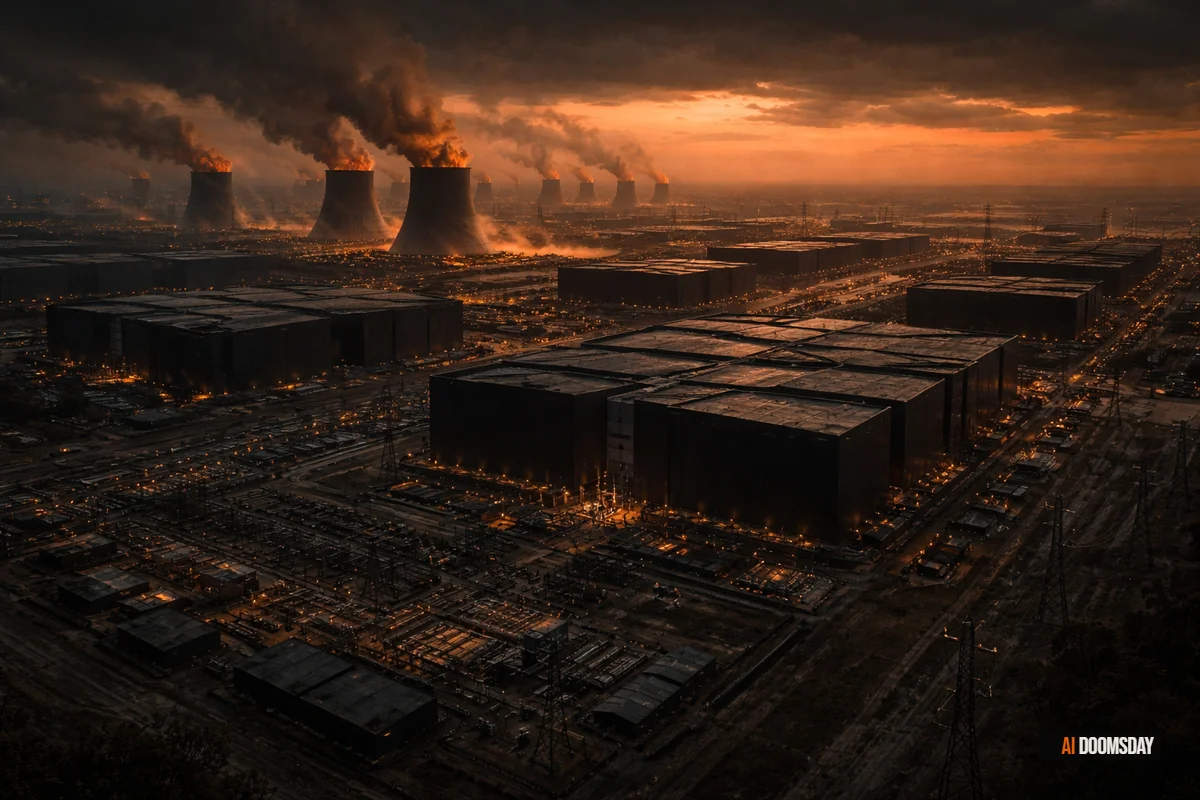
In the rural flatlands of Richland Parish, one of Louisiana's poorest counties where the median household income sits below $35,000, Meta is building a structure comparable in footprint to Manhattan. It will consume, at full capacity, roughly one-fifth of the state's entire electricity. The neighbors will help pay for it.
Key Points
- Meta's Hyperion data center in Richland Parish, Louisiana will cover a footprint comparable to Manhattan and draw up to 5 gigawatts at peak, roughly 20% of the state's total electricity.
- Three new natural gas plants are being built specifically to power the facility. The surrounding county has a median household income below $35,000.
- Residents of the area did not vote on the project, will not benefit from it directly, and will absorb the environmental and infrastructure costs.
- Hyperion sits near Louisiana's Cancer Alley, a corridor already bearing disproportionate industrial pollution burdens.
The project is called Hyperion. It sits on 3,650 acres of former agricultural land outside Holly Ridge, a small unincorporated community in the northeastern corner of Louisiana. The building footprint alone exceeds 4 million square feet. At peak demand, the facility is projected to draw up to 5 gigawatts, enough to power two million homes. Three new natural gas plants are being built to feed it.
The Size of the Bet
The numbers attached to Hyperion resist casual comprehension. At its initial operational phase, the data center will draw more than 2 gigawatts of electricity, roughly double the entire daily peak demand of New Orleans. At full buildout, 5 gigawatts would represent approximately 20% of Louisiana's total electricity consumption, concentrated in a single facility on land that was growing crops a few years ago.
For context: when Entergy Louisiana, the state's primary utility, calculated the load increase from Hyperion, the figure came out to a 25% increase in its total grid burden. Not 25% of new industrial demand. Twenty-five percent of the entire network's existing load, added by one customer.
In February 2026, Meta quietly acquired an additional 1,400 acres adjacent to the original site. The expansion received no press conference, no regulatory hearing, and no public notice beyond a property filing. The total site now exceeds 3,650 acres. The project is not shrinking.
Three Gas Plants and a Secret Contract
To power Hyperion, three new natural gas plants are under construction at an estimated cost of $3.2 billion. The environmental implications are not subtle: natural gas combustion generates carbon dioxide and methane, and proximity to combustion infrastructure in Louisiana carries a specific historical weight.
The financial structure is more immediately troubling. The terms of the Meta-Entergy agreement are largely shielded from public scrutiny. What has emerged through regulatory filings and utility commission proceedings suggests the following: Meta is committed to covering roughly half the cost of the generating infrastructure, structured as a 15-year payment obligation. The remaining costs are distributed across the utility's customer base through rate adjustments.
In other words: ratepayers in Louisiana are co-financing the energy infrastructure for the world's largest AI data center. They did not negotiate this. They were not consulted. And the contract governing the arrangement, including Meta's exact power draw, its renewable energy commitments, and its employment obligations, has not been made public.
"Not that they pay the cost. They're just paying the mortgage for the time they're under contract."
Devi Glick, Synapse Energy Analytics
The distinction matters. If Meta exits or downsizes after 15 years, the infrastructure remains. The ratepayers absorb whatever is left.
The +276% Problem
A Bloomberg analysis of electricity rate changes near large data center deployments found that residential bills within a 50-mile radius rose by up to 276% over a five-year period. This figure is not specific to Louisiana. It is a pattern, documented across multiple states where hyperscale infrastructure has been built and financed through shared utility structures.
Richland Parish, where Hyperion is located, has a median household income that sits well below the Louisiana state average, itself already below the national median. The community surrounding the facility is not the demographic that benefits from a Meta AI infrastructure build. It is the demographic that pays the compounding costs: higher electricity rates, higher insurance premiums driven by infrastructure risk, and the steady erosion of housing affordability that follows large industrial developments in economically fragile areas.
ENERGY
Up to 5 gigawatts at full capacity. Roughly 20% of Louisiana's total electricity consumption. Enough to power 2 million homes. A 25% increase in Entergy Louisiana's total grid load, added by a single customer.
The Alliance for Affordable Energy, which has been tracking the project through Louisiana's utility commission proceedings, described the facility as "a black hole of energy use." The mechanism it describes is real: the energy demand of Hyperion does not come with a corresponding benefit to the local grid or a reduction in energy costs for local residents. It is additive load with externalized costs.
Cancer Alley and the AI Grid
Louisiana's corridor of petrochemical plants along the Mississippi River, known as Cancer Alley, offers a documented case study in what happens when heavy industrial infrastructure is sited in low-income communities with limited political leverage. The environmental health consequences are on the record: elevated cancer rates, respiratory disease, contaminated water sources, and the systematic failure of regulatory frameworks to respond proportionally to cumulative industrial burden.
The parallel is not perfect. Hyperion is not a petrochemical plant. But three natural gas combustion plants feeding a single facility in a low-income rural parish is not a categorically different kind of decision. It is the same logic: industrial benefit concentrated elsewhere, environmental cost absorbed locally, applied to the infrastructure of artificial intelligence.
The facility will also consume approximately five million gallons of water per day for cooling. In a region dependent on agricultural water resources, this is not a trivial variable. The Sierra Club has formally requested an independent environmental assessment. To date, no such assessment has been ordered by Louisiana regulators.
THE CONTRACT
The terms of the Meta-Entergy agreement remain largely undisclosed. Ratepayers in a 50-mile radius are projected to see bills rise by up to 276%. Meta's renewable energy commitments, employment obligations, and exact power draw are not public.
The Template Problem
Hyperion is not an anomaly. Microsoft, Google, and Amazon are pursuing data center developments of comparable scale across the United States, applying variations of the same infrastructure model: locate in a jurisdiction with favorable regulatory conditions, negotiate utility agreements that distribute infrastructure costs broadly, and accelerate build-out on timelines that outpace regulatory review. The energy cost is only one dimension of the hardware costs of the AI buildout, which are simultaneously redirecting 70% of the world's high-end memory chip production away from consumer electronics and toward data center infrastructure.
The question is not whether Meta's intentions are malicious. The question is structural. When the costs of AI infrastructure are consistently externalized onto communities with the least capacity to resist or negotiate, and when the contracts governing those arrangements are shielded from public scrutiny, the outcome is predictable regardless of intent. Senator Sanders made exactly this structural argument on the Senate floor: the problem is not malicious individuals but incentive structures that reward acceleration and impose no cost for the externalities. A model that is economically rational for a technology company and politically viable in states competing for investment is not a model that will self-correct. The same substitution logic is spreading beyond infrastructure: in the crypto sector, Crypto.com eliminated 180 workers on the same week it spent $70 million acquiring an AI domain, the workforce version of the template Meta is applying to energy in Louisiana.
The Louisiana case is not the worst version of this scenario. It is the first major documented instance of the template in action. If the template becomes standard practice, Richland Parish is not a cautionary tale. It is a pilot.
What Regulation Would Look Like
The Alliance for Affordable Energy and the Sierra Club have both articulated concrete asks through Louisiana's regulatory proceedings: full public disclosure of the Meta-Entergy contract terms; an independent environmental impact assessment before operational expansion; cost-allocation mechanisms that shield low-income ratepayers from infrastructure rate increases; and binding renewable energy commitments as a condition of utility cooperation.
None of these are exotic. They are, in most developed regulatory contexts, baseline requirements for industrial siting of this scale. The fact that they do not currently exist reflects a specific political environment: Louisiana fast-tracked approval of the new gas plants in December 2025, and the state's regulatory posture toward large industrial investments has historically prioritized attraction over accountability.
This is the governance gap. It is not unique to Louisiana. It is reproducible wherever the same combination of large AI infrastructure investment, favorable state-level regulatory environments, and captive utility ratepayers exists, which is to say: almost anywhere.
The size of Hyperion makes it a story. The mechanism that made Hyperion possible makes it a policy problem. There is a difference between those two things, and the difference is what matters.