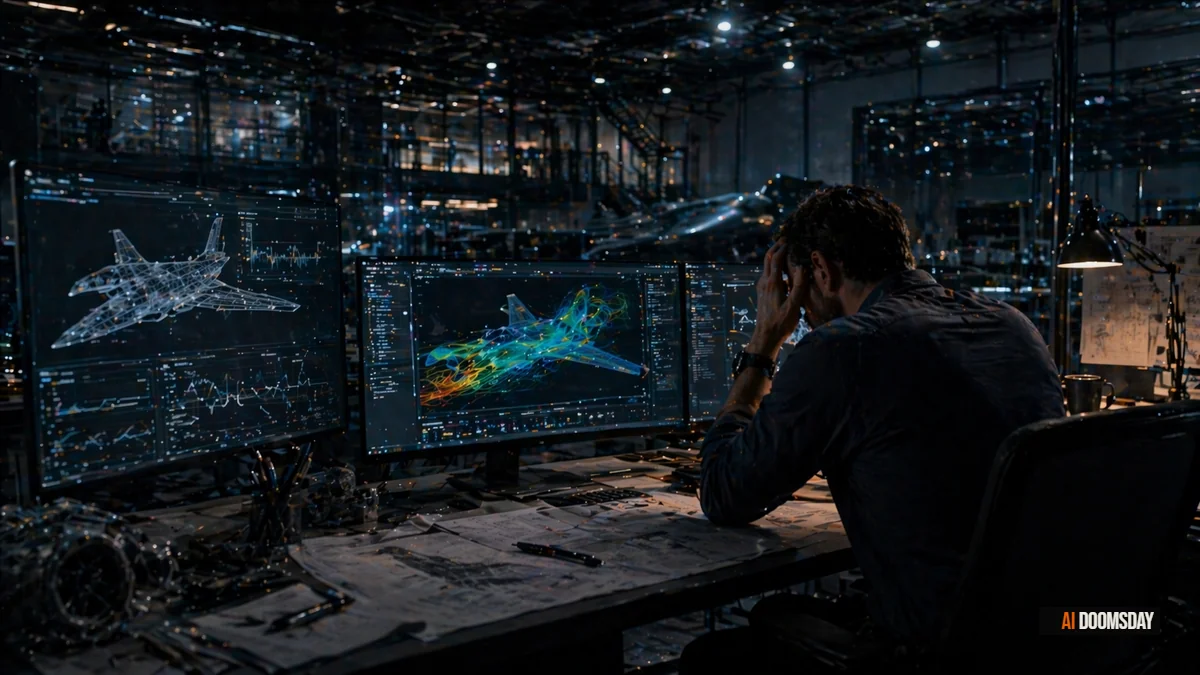
Aerospace engineering is one of the most technically demanding professions in the modern economy. It combines physics, materials science, thermodynamics, control systems, and structural analysis under conditions where failure is measured not in financial loss but in human lives. That complexity, and the regulatory architecture built around it, has historically protected aerospace engineers from the automation pressures that have already reshaped adjacent industries. The protection is real. But it is not permanent, and it is not as broad as the profession tends to assume.
The tools now entering aerospace workflows are not speculative. Generative design platforms, physics-informed neural networks, and AI-assisted compliance systems are already deployed at Airbus, Boeing, Lockheed Martin, and the emerging commercial space sector. What they are doing is not replacing the aerospace engineer as a credentialed professional. What they are doing is compressing the number of engineer-hours required to produce the same certified output. That distinction matters enormously for how the profession should understand its risk. The credential survives. The headcount does not.
McKinsey's automation research consistently flags engineering design and analysis as a high-productivity-gain domain for AI, with aerospace ranking among the sectors where simulation-driven tools deliver the largest measurable reductions in project labor. 2035 is the horizon in our model, not because the tools are not ready sooner, but because the regulatory certification cycles that govern aerospace product development operate on decade-long timescales. The FAA does not move at the speed of a software release. That delay is the profession's last structural advantage.
Key Points
- AI generative design tools, including Autodesk Fusion and NVIDIA Modulus, can explore thousands of structural and aerodynamic configurations in the time a human team would evaluate dozens, reducing the conceptual design phase from months to weeks on standard programs.
- Computational fluid dynamics simulation powered by physics-informed neural networks now delivers results at speeds 10 to 1,000 times faster than traditional CFD solvers, compressing what was once a multi-week analysis cycle into hours or days.
- McKinsey Global Institute identifies engineering design, analysis, and documentation as sectors with 25 to 40 percent automation potential using current AI systems, with aerospace among the highest-gain subsectors due to its simulation-heavy workflows.
- FAA and EASA certification requirements create a regulatory buffer that delays full AI integration into certified aerospace products, making 2035 a more realistic displacement horizon than the shorter timelines seen in software or finance.
- The contraction risk is concentrated in mid-level analysis and documentation roles, stress analysis engineers, aerodynamics specialists handling parametric studies, and technical writers producing compliance documentation, rather than systems architects or certification leads.
What an Aerospace Engineer Actually Does
The aerospace engineering profession spans a range of specializations that differ significantly in their exposure to AI automation. At the analysis and simulation end, engineers spend the majority of their working hours running parametric studies, evaluating structural loads, modeling aerodynamic behavior, and iterating on designs to meet performance and weight targets. This is technically demanding work, but it follows well-defined physical laws and applies established computational methods to structured inputs. It is precisely the category of work that AI simulation platforms are built to accelerate.
Above that sits systems integration and certification work: coordinating the interactions between propulsion, avionics, structural, and materials subsystems, and navigating the FAA or EASA certification process that governs every component of a certified aircraft or spacecraft. This work requires cross-domain judgment, regulatory fluency, and the ability to manage the interface between engineering design decisions and legal compliance requirements. It is more resistant to automation, but it is also far less common as a daily activity for most aerospace engineers.
At the senior end, aerospace engineering shades into systems architecture, program management, and advanced research. These roles involve defining requirements, managing trade-offs across competing constraints, and making decisions that cascade across entire programs. They are the most protected layer of the profession, and the smallest in headcount relative to the analysis-heavy middle.
What AI Is Already Doing Inside Aerospace
The automation of aerospace engineering workflows is not a future scenario. It is already inside the major programs at Airbus, Boeing, and the commercial space sector, operating as a productivity layer rather than a replacement system, but compressing hours in ways that are accumulating into structural workforce change.
Autodesk Fusion's generative design capability allows engineers to define performance constraints, including load cases, material limits, manufacturing method, and weight targets, and then receive hundreds or thousands of valid design candidates ranked by performance. A task that would previously require a team of stress and structural engineers working through months of iterative design is compressed into a process where the engineer's primary role is setting constraints and selecting among outputs. Airbus used this approach on the A320 partition bracket program, reducing component weight by 45 percent while cutting design iteration time by an order of magnitude.
THE COMPRESSION
A parametric aerodynamic study that a team of three CFD engineers would spend six weeks completing now runs in two to three days on NVIDIA Modulus with a single engineer managing the process. The analysis does not get worse. The team gets smaller.
NVIDIA Modulus, a physics-informed machine learning framework, enables CFD simulations at speeds that traditional finite element and fluid dynamics solvers cannot approach. Where a high-fidelity CFD run on a full aircraft configuration might take days on a high-performance computing cluster, Modulus-based surrogate models reduce that to hours or minutes once trained on the problem domain. For programs that require hundreds of parametric CFD runs across flight envelope variations, the productivity differential is not incremental. It is transformative.
On the compliance and documentation side, large language models are being applied to FAR and EASA regulatory lookup, automatically mapping design parameters to applicable certification requirements and flagging potential non-conformances before formal review. The Stanford AI Index 2024 documents rapid adoption of AI-assisted regulatory analysis tools across aerospace and defense, noting that several major contractors have integrated LLM-based compliance checkers into their design review workflows as of 2024.
The Regulatory Buffer and Its Limits
The FAA and EASA certification frameworks are the aerospace engineer's most significant structural protection against rapid AI-driven displacement. Certification of an aircraft type under 14 CFR Part 25 or its EASA CS-25 equivalent is a multi-year, document-intensive process that requires human signatory authority at every stage. AI systems cannot currently hold a Designated Engineering Representative credential or serve as the responsible engineer on a substantiation document. That legal requirement alone delays the point at which AI can fully replace human engineers in the certification workflow.
But the buffer is narrower than it appears. The regulatory requirement is for human sign-off, not for human analysis. An AI system can generate every substantiation calculation, every stress report, and every aerodynamic analysis that a certification package requires. A credentialed engineer reviews and approves it. The AI does the work. The engineer holds the pen. That model already exists in adjacent industries, and it is the direction aerospace is moving.
PwC's AI productivity research, covering engineering-intensive industries, identifies this "AI plus responsible engineer" model as the dominant adoption pattern in regulated sectors, projecting that by 2030 to 2032 it will be the standard operating model for aerospace certification-support work. The engineer's role does not disappear. It becomes supervisory. And supervisory roles require fewer people than analytical ones.
The Structure of Displacement in Aerospace
Gartner's IT and workforce analysis identifies the roles under most immediate pressure in aerospace engineering: parametric analysis engineers whose primary output is CFD and FEA studies, technical writers producing compliance documentation from engineering data, and junior structural engineers whose work focuses on standard load case calculations. These roles are not scheduled for elimination on a short horizon, but they are the categories where AI tools deliver the most direct productivity gain, and where headcount reductions relative to output are already measurable at firms that have adopted the current generation of tools.
The roles under least near-term pressure are systems architects defining requirements and trade spaces, certification leads managing FAA and EASA relationships, and propulsion and avionics specialists working at the intersection of multiple technical domains where AI context windows and training data are thinner. These roles exist at the top of the engineering pyramid, they are already scarce relative to demand, and they will remain scarce as AI compresses the base beneath them.
The pattern in aerospace mirrors the pattern seen in accounting and legal: AI removes the analytical base of the pyramid before it affects the judgment apex. In aerospace, the base is particularly large because decades of high capital expenditure and complex program structures have sustained large teams of mid-level analysis engineers. Many of those positions will not be refilled when they turn over. The programs will not shrink. The teams will.
How to Use AI as an Aerospace Engineer Now
The aerospace engineers who will retain leverage through 2035 and beyond are those who treat generative design and simulation AI as professional tools rather than competitive threats. The workflow logic is consistent with what is happening in every other engineering-adjacent profession: automate the parametric and iterative work, own the constraint-setting and judgment layer, and use the time differential to build the systems-level knowledge that AI cannot replicate from simulation data alone.
For design and structural work: Autodesk Fusion's generative capabilities, used competently, allow a single engineer to explore a design space that would previously require a team. The engineer's value is not in running the analysis. It is in knowing which constraints to set, which outputs to reject, and why the simulation result does not match the physical intuition built from years of program experience. That judgment is not in the training data.
For simulation and CFD: NVIDIA Modulus and equivalent physics-informed ML frameworks are becoming standard infrastructure at major contractors. Fluency with these tools is not optional for engineers who want to remain relevant in an analysis role through the late 2020s. The engineer who can set up a Modulus surrogate model, interpret its outputs, and identify when it is extrapolating outside its training distribution is more valuable than the engineer who can run a traditional CFD solver more carefully.
For regulatory and compliance work: LLMs trained on FAR, EASA CS-25, and MIL-SPEC documentation are available now and produce useful first-pass regulatory lookups at speed. Using them to accelerate compliance research, while applying human judgment to the edge cases and ambiguities, compresses the documentation phase of certification programs significantly. Engineers who can manage this interface are building a skill the profession will need for the next decade.
What I Think
The 2035 Moderate-risk horizon is, in my assessment, accurate for the credential but conservative for the headcount. The regulatory certification buffer is real and will hold the formal displacement timeline to the mid-2030s for most aerospace engineering functions. But the compression of engineering hours per project is already happening, is already measurable at the firms using current-generation AI tools, and is already reducing the number of engineers hired per program relative to historical baselines. 2035 is when the displacement becomes statistically visible in employment data. The process started years ago.
What concerns me specifically about aerospace is the certification pipeline problem. The pathway to becoming a certification lead or systems architect in aerospace runs through years of detailed analysis work: running stress studies, interpreting CFD results, writing substantiation reports, and developing the physical intuition that makes senior engineering judgment credible. If AI compresses the mid-level analysis layer before the people in it have developed that intuition, the profession does not just lose headcount. It loses the experience structure that has historically produced its senior talent. The simulation can know more than the junior engineer. It cannot know more than the experienced one. But it can prevent the junior engineer from ever becoming experienced.
The aerospace engineer's strategic position in 2026 is to move up the value chain faster than the AI tools are moving up it from below. That means building regulatory knowledge, systems-level judgment, and cross-domain fluency while using AI to handle the parametric work that would otherwise consume the majority of working hours. It is a viable strategy. It requires deliberate effort. And it requires starting now, not in 2034.
"The simulation can already explore a design space that would take a human team a year. The question is not whether aerospace engineers will be replaced. It is whether the ones who survive will understand why the simulation chose what it chose, or whether they will just approve it."