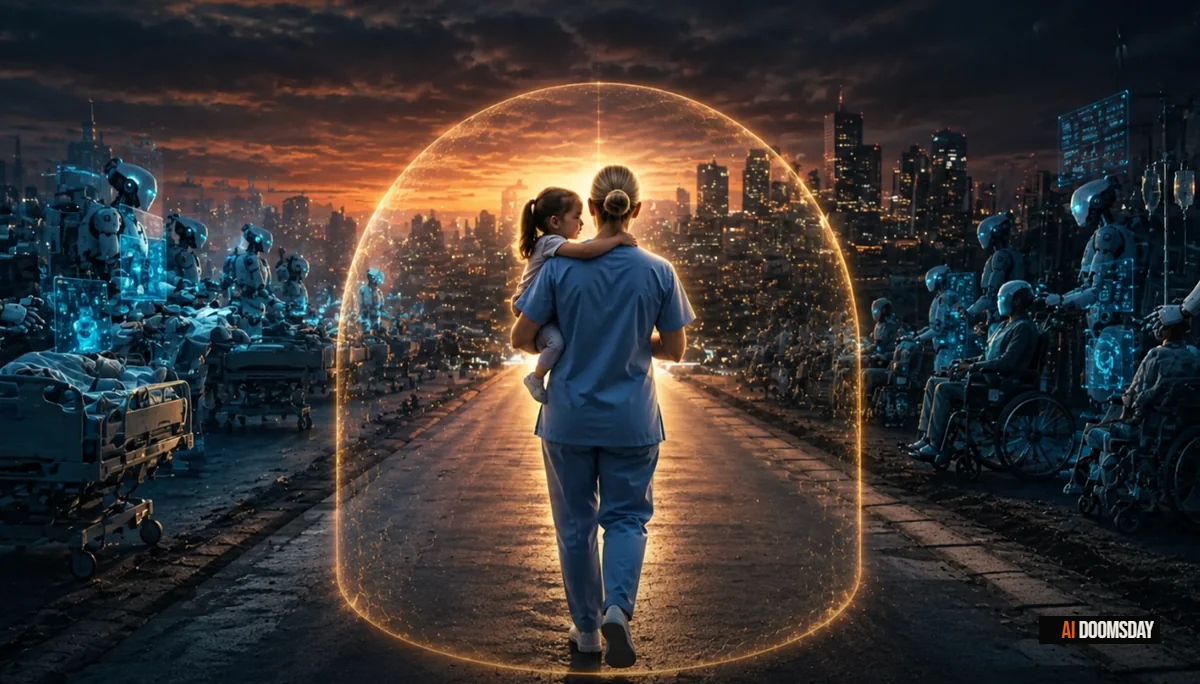
Nursing is built on a form of labor AI cannot simulate: a hand on a patient's shoulder at 3 a.m., a judgment call made in the ninety seconds before a monitor confirms what a trained eye already suspects, the sustained emotional presence required to sit with someone through fear, pain, or dying. It is also, increasingly, a profession buried under documentation that has nothing to do with any of that.
The displacement risk is classified as Low, with a horizon toward 2035. That number holds up under scrutiny. Direct patient contact, real-time clinical judgment, and emotional labor sit almost entirely outside what current AI systems can perform. But the software surrounding the job, the charting, the early-warning monitoring, the triage support, is advancing quickly, and it is already changing how much of a nurse's shift is actually spent with a patient rather than a keyboard.
The question is not whether nurses will be automated away. On the evidence, they will not, not within any planning horizon that matters. The more urgent question is whether the profession can retain the people it already trained, in a system where burnout, not artificial intelligence, is the force actively pushing nurses out of bedside care.
Key Points
- Nurses are rated Low risk with a displacement horizon toward 2035, protected by direct patient contact, real-time clinical judgment, and emotional labor that AI cannot replicate.
- McKinsey's research with the American Nurses Foundation found nurses themselves estimate AI could free up roughly 20% of a shift currently lost to administrative and documentation work, not to patient care.
- Ambient AI scribes like Abridge, deployed with Mayo Clinic and Epic, and Suki, already in use across multiple health systems, cut out-of-hours documentation time by double-digit percentages in published studies.
- AI early-warning systems, including sepsis-prediction models studied across thousands of patients, have been associated with double-digit reductions in mortality when paired with nurse-led monitoring.
- The U.S. Bureau of Labor Statistics projects registered nurse employment to grow faster than average through 2034, yet the American Nurses Association reports burnout, not automation, as the primary reason nurses leave bedside roles.
What a Nurse Actually Does
The title spans a wide range of clinical settings, but the core of the job is consistent: administering medication, monitoring vital signs and clinical status, coordinating care with physicians and specialists, educating patients and families, and responding, often in real time, to conditions that change faster than any scheduled check-in. In acute and critical care, that responsiveness is the job. A nurse who recognizes early, subtle deterioration before it becomes a documented emergency is doing the highest-value work in the entire care pathway.
Around that core sits an enormous administrative layer: charting every observation and intervention, documenting medication administration, completing assessments required by regulation and liability, and generating the paper trail that hospitals need for billing, compliance, and quality reporting. A 2024 survey by the American Medical Informatics Association found that documentation now consumes roughly 23% of a twelve-hour nursing shift. That is nearly three hours a day spent typing instead of treating.
What AI Is Already Doing
The tools reshaping nursing right now are not replacing clinical judgment. They are absorbing the paperwork that judgment gets buried under.
Ambient AI scribes are the clearest example. Abridge, developed in partnership with Mayo Clinic and Epic, listens to clinical encounters and generates structured documentation in real time, specifically built for nursing workflows. Suki's ambient platform has shown reductions of 35 to 65% in after-hours documentation across hospital deployments, with notes completed roughly 41% faster. A multicenter study covering 263 clinicians found that after 30 days of using an AI scribe, self-reported burnout dropped from 51.9% to 38.8%, a 74% reduction in the odds of burnout, alongside measurably lower cognitive load and less after-hours charting.
THE TRADE
Documentation that used to take a nurse ten minutes per patient encounter now takes an ambient scribe under a minute to draft, leaving the nurse to review and sign rather than type from scratch. The time does not disappear from the shift. It moves from the keyboard back to the bedside, which is the opposite of what automation does in most other professions.
On the clinical side, AI early-warning systems are catching deterioration before it becomes a crisis. The InSight algorithm, studied prospectively across more than 75,000 patients in nine U.S. hospitals, predicted sepsis up to 48 hours before clinical onset and was associated with a 39.5% reduction in mortality and a 22.7% drop in hospital readmissions. Duke Health's Sepsis Watch, a real-time deep learning system used in its emergency and intensive care units, was linked to a 27% reduction in sepsis mortality after deployment. These systems do not diagnose or treat. They flag risk earlier than a chart review would, and the nurse still makes the call, the same division of labor AI Doomsday found in diagnostic imaging for cardiologists.
AI triage tools are also entering emergency and telehealth workflows. Banner Health, one of the largest nonprofit health systems in the country, deployed Buoy Health's AI-assisted triage platform to help route patients toward the right level of care, telehealth, urgent care, or the emergency department, before they arrive. A peer-reviewed comparison published in JMIR mHealth found AI symptom checkers like Ada Health matched physician triage recommendations in roughly 62% of cases, with the lowest rate of unsafe recommendations among the tools tested. These systems support the initial sorting of patients. They do not replace the nurse who assesses them in person.
Where the Physical and Emotional Work Resists Automation
The Low-risk classification rests on a structural fact that McKinsey's automation research has repeatedly confirmed: healthcare overall carries meaningful technical automation potential, but the share of a nurse's actual time that can be automated is far lower than the sector average, closer to 20%, precisely because so much of the job is physical contact, in-the-moment judgment, and sustained emotional presence with another human being in distress. Software does not hold a hand. It does not read the flicker of fear in a patient's face that prompts a nurse to ask one more question before leaving the room.
That protection is closely related to the same dynamic covered in Microsoft's research on jobs most exposed to AI, which found that occupations built on physical presence and real-time human response sit consistently at the low end of AI exposure, nursing among them. It is a different exposure profile than the one facing diagnostic specialties like radiology, where the core task is pattern recognition in an image, work far closer to what current AI systems do well.
The Real Shortage Is Burnout, Not Automation
The U.S. Bureau of Labor Statistics projects registered nurse employment to grow 5% through 2034, faster than the average occupation, with roughly 189,100 openings a year. On paper, that looks like a growing, healthy profession. In practice, the American Nurses Association's most recent workforce survey of over 12,500 nurses found that 57% report exhaustion, 43% report clinical burnout, and only 20% feel valued by their institution. An estimated two million licensed registered nurses in the United States are not currently working in bedside care at all, not because the jobs disappeared, but because the people who trained for them left.
This is the inversion that makes nursing different from most professions AI Doomsday tracks. In law, in accounting, in entry-level sales, AI compresses headcount because it can perform the underlying task faster and cheaper. In nursing, AI is being deployed specifically to reduce the administrative burden that is driving people out of a job the technology cannot actually do. If ambient documentation and early-warning systems succeed at what the early data suggests, the effect on the nursing shortage would be additive, not substitutive, keeping more trained nurses at the bedside rather than replacing them with software.
How to Use AI as a Nurse Now
The nurses and health systems getting the most from these tools right now are not the ones anxious about replacement. They are the ones using AI to reclaim time that documentation was quietly taking from patient care.
For documentation: ambient scribes like Abridge, Suki, and Nabla are best treated as a first draft, not a final note. Review what the system generates against your own clinical judgment before signing. The tool accelerates transcription. It does not replace the nurse's responsibility for accuracy.
For monitoring: early-warning systems are a second set of eyes, not a replacement for bedside assessment. A flagged risk score is a prompt to look closer, not a diagnosis. The systems with the best outcomes data, InSight, Sepsis Watch, are the ones deployed alongside nurse-led response protocols, not instead of them.
For triage and patient education: AI symptom checkers and LLM-based patient materials are useful for a first pass and for reducing the volume of low-acuity questions competing for a nurse's attention. They are not a substitute for the clinical conversation that determines what a patient actually needs.
What I Think
The 2035 horizon looks right to me, and possibly conservative. Every serious study of automation potential in healthcare draws the same line: the parts of nursing that involve a monitor, a keyboard, or a risk score are automatable, and the parts that involve a human body and a frightened person are not, and there is no credible research pathway that closes that gap in the near term.
What concerns me is not AI's effect on the nursing profession. It is that the industry may treat the productivity gains from ambient documentation and early-warning systems as a justification for leaner staffing ratios, rather than as relief for the nurses already stretched past capacity. The data on burnout is not ambiguous. Nearly half of nurses report exhaustion, and a quarter are considering leaving the profession within a year. AI that frees up three hours of a shift can either go back to patients or get absorbed by a hospital trying to do more with fewer people. Which one happens is a staffing decision, not a technology decision, and it is the one that will actually determine whether the nursing shortage gets better or worse over the next decade.
"AI can draft the chart note and flag the falling vital sign. It cannot sit with someone at 3 a.m. and tell them, credibly, that they are not alone. That is the job, and it is not going anywhere."