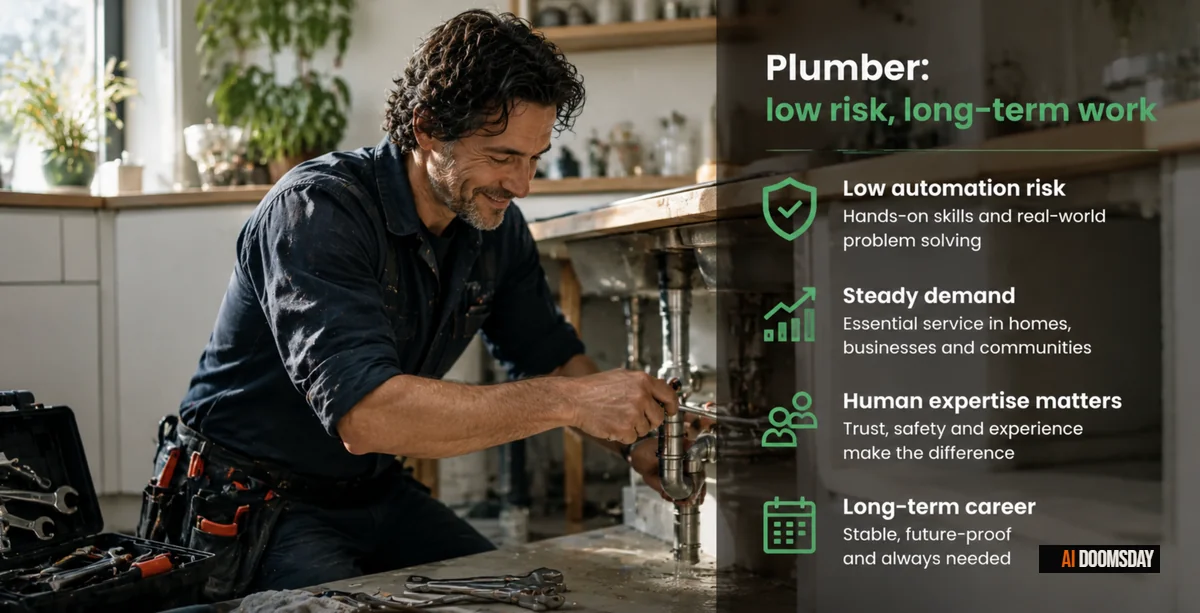
Plumbing is one of the least glamorous, most structurally protected jobs in the entire economy. It requires bodily strength, tolerance for filth and confined spaces, and a form of improvisational judgment that no manual fully captures, because no two houses were built exactly the same way. It is also, by nearly every serious industry assessment, one of the hardest jobs on earth for AI to touch.
The displacement risk is classified as Low, with a horizon stretching toward 2055. That number is not a hedge. It reflects something structural: the core of what a plumber does, diagnosing a failure in a system it cannot see, then physically reaching into a wall, a crawlspace, or a slab to fix it, sits almost entirely outside the domain where current AI systems operate. Software does not have hands. But the tools around the trade, the sensors that detect the leak, the software that schedules the callout, the app that writes the invoice, are already changing how the job gets done and who gets to do it.
The question is not whether plumbers will be automated out of existence. On the available evidence, they will not, not in any horizon worth planning around. The more interesting question is what happens to a trade that AI cannot replace, in an economy that is simultaneously running out of people willing to enter it.
Key Points
- Plumbers are rated Low risk with a displacement horizon toward 2055, among the most protected classifications AI Doomsday tracks.
- McKinsey Global Institute's automation research finds installation, maintenance, and repair work, physical manipulation in unstructured environments, sits at the low end of automation potential, unlike routine office and knowledge work.
- PwC's 2026 Global AI Jobs Barometer reports that occupations least exposed to AI, physical trades among them, are adding workers roughly 20 times faster than the most exposed knowledge-work fields.
- The U.S. Bureau of Labor Statistics projects plumbing employment to grow 4% through 2034, with roughly 44,000 openings a year, a shortfall the trade cannot currently fill.
- AI is entering the trade through smart leak-detection sensors, AI-assisted dispatch software, and pipe-inspection robotics, tools that reduce emergency callouts and administrative overhead without replacing the person doing the repair.
What a Plumber Actually Does
The job title covers a wider range of work than most people realize. At its core, a plumber installs, repairs, and maintains the systems that move water, gas, and waste through a building: supply lines, drainage, venting, fixtures, water heaters, and increasingly, the smart devices bolted onto all of it. Residential plumbers handle leaks, clogs, fixture installs, and water heater replacement. Commercial and industrial plumbers work on larger systems, often under code requirements that carry real safety and legal weight.
What makes the job hard to automate is not any single task. It is the combination of physical access, in a crawlspace, behind a wall, under a slab, with diagnostic reasoning under uncertainty. A pipe rarely fails in a way that matches the drawing. Water finds the path of least resistance, not the path a schematic assumes, and a plumber's real skill is often figuring out where a problem actually originates, not just where it surfaces. That is a form of expertise built from thousands of hours of direct, physical, non-repeatable experience.
What AI Is Already Doing
The tools reshaping plumbing are not robots doing the repair work. They are systems that sit around the job: detecting problems earlier, routing the right technician faster, and automating the paperwork that used to eat into a plumber's evening.
Smart water monitors are the clearest example. Moen's Flo Smart Water Monitor and Shutoff uses AI, marketed as FloSense technology, to learn a home's normal water-usage pattern and flag anomalies, detecting leaks as small as one drop per minute and automatically shutting off the main supply before a slow leak becomes a flooded basement. Moen reports that roughly 60% of new adopters discover a previously unknown leak within the first 30 days of installation. Phyn's Plus Smart Water Assistant works on a similar principle, using pressure-wave analysis to distinguish a dripping faucet from a burst pipe from a running toilet, and to catch frozen-pipe bursts before they cause structural damage.
THE INVERSION
In most white-collar professions, AI compresses the labor and the same number of problems get solved by fewer people. In plumbing, AI compresses the detection, catching leaks earlier, more precisely, before a callout turns into an emergency, but the physical repair still requires a licensed person on site. The technology shrinks the crisis. It does not shrink the crew.
On the business side, field-service platforms like ServiceTitan and Housecall Pro now use AI for dispatch optimization, routing technicians to minimize drive time and fuel cost, alongside automated estimating, invoicing, and follow-up messaging. For a small plumbing outfit, this is not a marginal convenience. Administrative work, scheduling, quoting, chasing payment, has historically consumed hours that could otherwise go toward billable repairs. Compressing that overhead is one of the more meaningful ways AI is currently changing the economics of the trade, without touching the wrench work itself.
At the infrastructure level, inspection robotics are doing work that used to require cutting into a wall or excavating a trench. Sewer and pipe inspection crawlers, systems like Envirosight's ROVVER X, drive cameras and laser-measurement tools through pipes from 6 to 96 inches in diameter, sizing defects without disruptive excavation. More experimental systems, like Acwa Robotics' AI-guided Pathfinder, navigate active drinking-water mains without requiring a shutoff, screening for corrosion and micro-cracks. These remain primarily utility-scale tools, not yet standard equipment for a residential plumber's van, but they represent the direction the diagnostic side of the trade is heading.
Where the Physical World Resists Automation
The Low-risk classification and the 2055 horizon rest on a straightforward structural fact. McKinsey Global Institute's research on automation potential has consistently found that jobs requiring physical manipulation in unpredictable, unstructured environments, exactly what a plumber does under a sink or inside a crawlspace, sit at the low end of what current and near-term automation can reach. Routine, structured, predictable work automates first. Improvised physical work, in spaces a robot cannot reliably navigate, automates last, if at all.
PwC's 2026 Global AI Jobs Barometer puts a sharper point on it: occupations least exposed to AI, physical trades among them, are adding workers at roughly 20 times the rate of the occupations most exposed to AI. That is not a marginal gap. It is a structural divergence between physical and knowledge work that has been building for several years and shows no sign of narrowing, and it extends to the trade-adjacent roles that inspect the work, as AI Doomsday's analysis of the building inspector covers.
Layered on top of that structural protection is a labor shortage that has nothing to do with AI and everything to do with demographics. The Home Builders Institute's fall 2025 construction labor market report estimates the industry needs roughly 723,000 new workers a year to meet demand, a shortfall that has already added billions in carrying costs and stretched build timelines. The U.S. Bureau of Labor Statistics projects plumbing employment to grow 4% through 2034, roughly in line with the average occupation, with about 44,000 openings a year, driven as much by retirements as by new demand. Fewer young people are entering the trades than are leaving them. AI is not the constraint on this profession's future. People are.
That imbalance was, in part, the subject of Larry Fink's widely quoted 2026 comments arguing that the economy needs more plumbers and fewer lawyers, a claim examined at length in The Plumber Speech. The uncomfortable arithmetic behind that speech applies just as directly here: even a trade with near-total protection from automation cannot benefit from that protection if there is no one training to do the work.
How to Use AI as a Plumber Now
The plumbers and small trade businesses gaining the most from AI right now are not the ones worried about being replaced. They are the ones using the new tools to run leaner, better-documented, faster-responding operations.
For diagnostics: smart monitors like Flo and Phyn are increasingly something a plumber recommends and installs for a client, not a threat to the plumber's job. A homeowner with an installed leak sensor calls earlier, with better information, often before a slow leak becomes a structural repair. That is a better job to walk into, not a lost one.
For dispatch and admin: platforms like ServiceTitan and Housecall Pro turn hours of manual scheduling and invoicing into minutes. For a solo operator or a small crew, that time returns directly to billable hours or, just as valuably, to actually going home at a reasonable time.
For diagnosis on hard jobs: inspection cameras and AI-assisted defect detection are moving from utility infrastructure toward higher-end residential and commercial work. A plumber who can read a AI-flagged pipe scan competently, rather than guessing where to cut, will do faster, less destructive, more trusted work than one who cannot.
What I Think
The 2055 horizon is, if anything, conservative. Every serious automation study points the same direction: unstructured physical labor is the hardest category for AI to reach, and plumbing sits near the extreme end of that category. Robotics capable of navigating an arbitrary crawlspace, identifying an undocumented pipe run, and executing a compression fitting by feel do not exist in any form close to commercial deployment, and nothing in the current pace of robotics research suggests that changes within a decade.
What concerns me is not the plumbing trade's exposure to AI. It is the gap between how protected this work actually is and how few people are choosing to enter it. A profession that is structurally safe from automation should, in theory, be an obvious refuge for workers displaced from more exposed white-collar fields. In practice, the trades carry a status penalty that has nothing to do with economics and everything to do with perception, and that penalty is proving harder to correct than any technical problem AI has solved so far.
The plumbing trade is not going anywhere. The open question is whether enough people show up to do it. Based on the current pipeline, the shortage, not the software, is the more likely constraint on this profession over the next thirty years.
"AI can tell you exactly where the pipe is leaking. It still cannot climb into the crawlspace and fix it. That gap is the plumbing trade's entire margin of safety, and it is not closing."